Beyond ESG: Where can your money make a big difference?


January: a time for reset and rebalance. I've recently overhauled my pension to be more values-aligned. Fossil fuel exclusions are an easy choice - especially given how quickly renewables are expanding, even with Trump's attempts to change course. Other screens require harder judgement calls. But as I worked through this rebalancing, a familiar question surfaced: how much does this actually matter?
Values alignment matters to me ethically - my investments should reflect who I am. Yet the honest answer is that secondary market trading has limited real-world impact. Even if I sell, by definition there is always another buyer. Companies don't actually receive my money. I'm simply choosing which assets sit in my portfolio. It's ethically meaningful to me, but it's not going to bend the global emissions curve.
This raises a bigger question: if we genuinely want to build the future we hope to see, where can our money make a real difference?
A Hierarchy of Impact
Two concepts are key: additionality and leverage. Additionality asks: would this outcome have happened anyway without my contribution? Leverage asks: how much impact does each pound unlock?
Using this lens, different forms of capital offer different potential.
Pensions struggle to score highly on either count. There are people in the industry actively trying to change that. But for now, the sheer scale of public markets means your available choices hardly move the needle. ESG funds may tilt your portfolio, but they don't tilt the world.
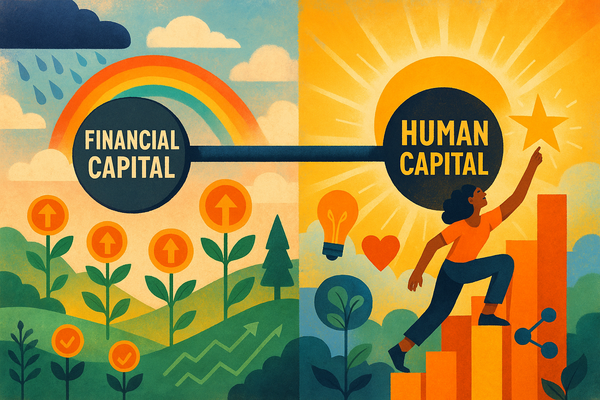
Financial investments outside of your pension offer more flexibility. Backing a community energy project or an early-stage climate venture can create real additionality. Your contribution (alongside others) might help make something possible that wouldn't otherwise exist. This comes with a trade-off of higher risk and/or illiquidity, which requires careful planning, but impact is clearly stronger.
Then there's human capital - often underappreciated and underestimated. Investing in your skills or retraining can open up new career possibilities. It can lead to greater career longevity and earning potential that far exceeds the initial investment. Taking the time to start a purpose-driven business is higher risk, but higher potential too, both financially and in terms of impact.
But there's one more level: Giving. Strategic giving, done well, can achieve what other approaches struggle to deliver: systems change. Rather than working within markets, philanthropy can reshape the rules those markets operate by. For high earners with less time or opportunity for hands-on involvement, "earning to give" offers a different path - channelling financial success into outsized impact.
Establishing Your Framework
So if giving has this potential, where do you start? Before asking where, there's the first question: how much?
A systematic approach to giving has deep roots. In Islam, for example, Zakat requires contributing 2.5% of accumulated wealth annually - not just as charity, but as a moral obligation. Similar principles exist in other faiths too. These numbers aren't arbitrary - they represent a commitment to making giving part of how we live, not an afterthought for when there's extra.
In the business world, movements like 1%-for-the-Planet formalise this thinking. Planet Positive Planning has made this pledge - 1% of profits to environmental causes. It's modest in percentage terms, but the commitment matters more than the amount. It's a shift to structural intention that can be built on over time.
The Effective Altruism movement takes this a step further: as well as how much, it emphasises rigorous analysis of how effective. Give deliberately. Give where evidence suggests the greatest impact. Some adherents commit to 10% of income through Giving What We Can; others simply bring analytical discipline to whatever they give.
The common thread? Having a framework. A number. A commitment. Once that's established, the real question emerges: how do you maximise impact per pound given?
Finding Guidance
This is where research matters. Fortunately, others have done the hard work.
Giving Green is an organisation dedicated to exactly this question: where can climate-focused giving achieve the most? They apply rigorous analysis to identify high-impact opportunities. They go beyond feel-good metrics to assess what actually shifts the needle on emissions.
They have a solid track record. In late 2025, they announced $26 million in grants to climate non-profits. This is their largest cycle yet. The grants cover clean energy policy, aviation emissions, and decarbonising heavy industry. For every dollar donated to support their research, they believe they can unlock $21 for effective climate solutions.
For those of us without the time or expertise to evaluate every charity ourselves, Giving Green offers a credible shortcut. Let's look at three examples from their research that illustrate different paths to impact.

Three Example Paths
Clean Cookstoves: Reframing Carbon Credits
Carbon credits have a credibility problem. The moral hazard argument is familiar: buying offsets lets people avoid the harder work of cutting emissions. But what if we reframe them as philanthropy rather than offsets?
BURN manufactures fuel-efficient cookstoves across Africa. The impact case has strong evidence. A randomised controlled trial found that households cut charcoal use by 39%, with this effect being durable over time. But the story extends well beyond emissions.
Families using BURN stoves save around $119 per year on fuel - roughly a month's income for many households. Women gain nearly an hour daily previously spent cooking. Indoor air pollution drops by up to 65%. This is emissions reduction wrapped in poverty alleviation, health improvement, and empowerment. When viewed as giving rather than offsetting, the moral hazard objection falls away. You're not buying absolution; you're funding genuine, measurable impact.
Policy Change: The Multiplier Effect
Direct action has limits. You can only insulate so many homes, install so many solar panels. You can only reduce your own carbon footprint by as much as you emit. But policy change operates at a different scale entirely.
A single well-designed regulation can shift millions of decisions simultaneously. Giving Green's research shows that funding policy advocacy, even with conservative assumptions, can deliver returns that dwarf more direct interventions. The leverage is structural - you're not pushing individual outcomes but reshaping the system that produces them.
Take this one step further: funding research into which policies might work is itself a multiplier on a multiplier. The insight that identifies an effective intervention unlocks all the impact that follows. This is what systems change looks like in practice.
Contrails: A Hidden Opportunity
Here's a climate problem most people have never heard of. Those white trails behind aircraft? Contrails may contribute as much to aviation's warming effect as its CO₂ emissions - potentially accounting for 1-2% of total global warming.
The remarkable finding: just 2-10% of flights create around 80% of contrail warming. These flights pass through specific cold, humid zones where persistent contrails form. Reroute them - fly slightly higher, lower, or around these zones - and the warming effect largely disappears.
The cost? Potentially as low as $1-6 per tonne of CO₂-equivalent avoided, making it one of the cheapest climate interventions available. Yet this area currently receives less than $5 million in philanthropic funding annually. It's a textbook case of high leverage meeting chronic underinvestment - exactly the kind of opportunity strategic giving can unlock (for more see report).
Beyond The Numbers
Having made the case for high-leverage, research-backed giving approaches, I also want to offer a counterweight.
The examples above are powerful because they can scale. A technology that impacts millions, policy change and systems-level interventions - these operate at a distance, impacting millions of people you'll never meet. That's a strength. But also, in a sense, it can have its own limitations.
Ultimately the deepest leverage of all is something that is hard to measure: changing mindset. Shifting our culture from one based on an individualistic mindset to a collective one instead. That doesn't happen through global policy. It happens in communities, through relationships and trust.
Local giving builds this social fabric. Supporting a community garden, a local foodbank, or a nearby rewilding project may not score highly in cost-per-tonne analysis. But they do something else. They make climate action visible, relatable and shared. They rebuild the trust that collective action depends on.
There's also something to be said for immediacy and visibility. Global giving requires faith that your contribution matters somewhere far away. Local giving lets you see the impact, know the people, feel part of something tangible.
My own view? It's not either/or. A balanced approach combines high-leverage global giving for maximum climate impact with local contributions that build the community connections that make sustained action possible. Head and heart, working together. If we're to really move the dial, we need both.
What About You?
So where does this leave you?
Start with a commitment. A percentage of income, of profits, of time - whatever feels sustainable and real. The number matters less than having one at all.
Then consider the balance. Perhaps the majority goes toward high-leverage opportunities – the kind of research-backed, systems-level giving that Giving Green and others can guide you toward. And perhaps a portion stays local, visible, relational – reinforcing the community fabric that makes collective action possible.
This isn't about perfection. It's about intention. Values-aligned investing, purposeful career choices, strategic giving - these aren't competing priorities. They're different expressions of the same question: what kind of future do I want to help build?
For some, giving might already be part of the picture. For others, it might be the missing piece that enables you to scale your beneficial impact on the world. Either way, building a framework - even a simple one - can turn good intentions into lasting impact.
What might yours look like? If this has sparked any thoughts, or if you'd like to explore how giving could fit into your own financial plan, hit reply - I'd love to talk more.
Disclaimer:
The information provided is for general informational purposes only and does not constitute investment, financial, tax, or legal advice. Please be aware that an investment strategy that is appropriate for one person, may not be appropriate to another, including yourself. Past performance is not indicative of future results. In tailoring your own personal investment strategy it is recommended to speak to a qualified professional.