What does hope for the future really mean?
Four hours in the heat of Pompeii, and two energy reports that seem to contradict each other — a reflection on what credible hope actually rests on, and one very practical place to start.

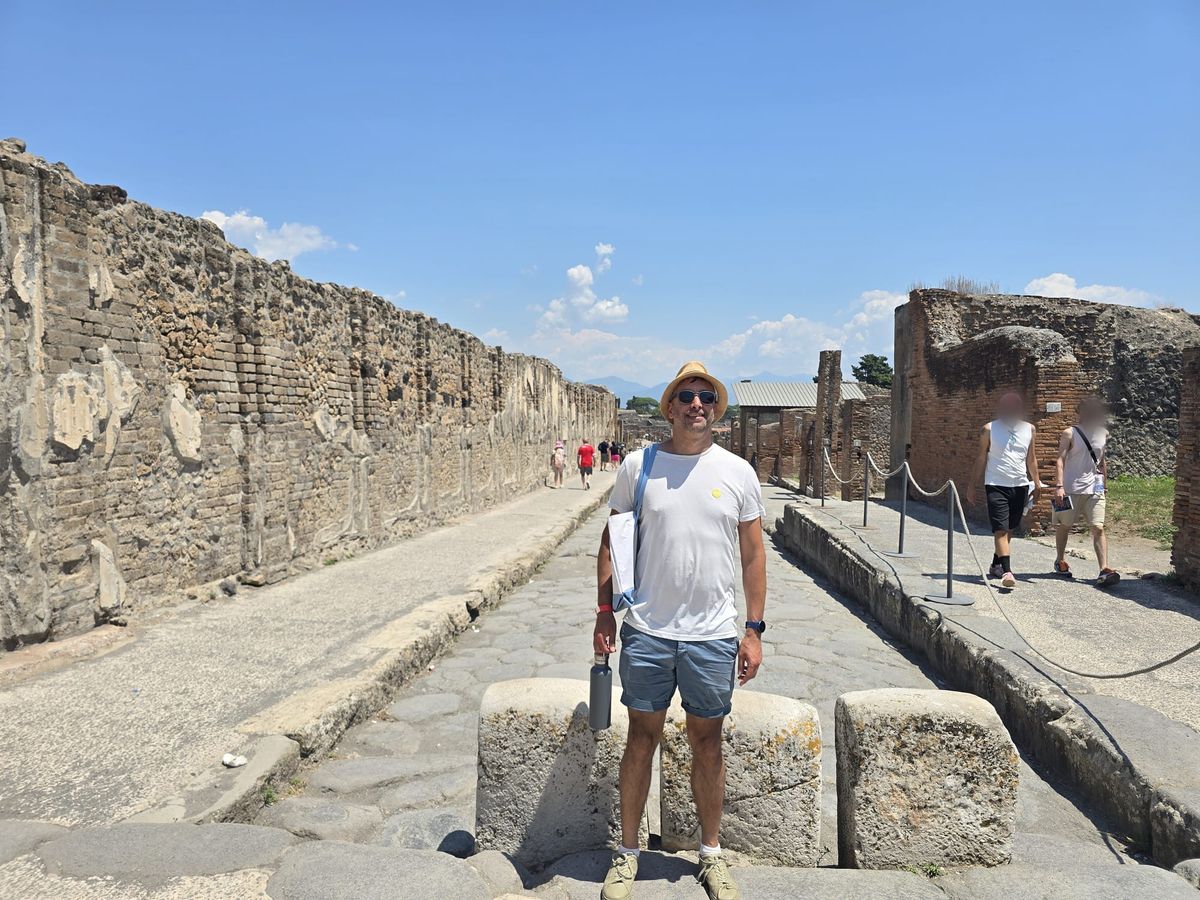
A fascinating four hours last week. Wandering the streets of ancient Pompeii. Learning about the lives of people ~2,000 years ago, in the actual houses and streets that they lived in. But by early afternoon, the heat defeated us. It felt like we were baking in an open air version of the preserved ancient pizza oven we'd seen in one of those villas! I discovered a new respect for anyone who has to work in conditions like this.
I imagine many of us have experienced similar with the heatwaves rolling through Europe this summer. Climate change has stopped being an abstract number or future scenario, and become something you feel on your skin. We're all finding out, viscerally, how hard it is to stay productive, to keep a home cool, to ventilate a bedroom enough to sleep. And quietly realising that we'll be doing more of this, not less, in the years ahead.
Echoes from Pompeii
Pompeii is, of course, one of the world's most famous reminders that nature can be brutal to humanity. Particularly to those who carried on with normal everyday life as the warning signs mounted around them.
But there's a quieter echo in those stones that struck me more. Pompeii's public life — its baths, its theatre, its forum buildings — wasn't funded the way we'd expect today. The Romans had a practice historians call euergetism: the wealthy earned their status by personally paying for public infrastructure. The inscriptions are still there. The grand building on the forum's edge carries the name of Eumachia, the priestess who funded it. The Holconii brothers paid for renovations to the theatre. And across Roman towns like Pompeii, magistrates paid a fee on taking office — the summa honoraria — that funded public games and building works. In Pompeii, you displayed your wealth by building things everyone could use.
I'll leave you to draw your own comparison with how status is displayed today. But it's heartening to hear that this concept — building for the commons — was something that was once an accepted cultural norm.
A warning and an inheritance, in the same stones. The Pompeiians couldn't read their warning signs — the science didn't exist. We can read ours. What we do next comes down to resisting two equally futile temptations.
Neither doom nor denial
The first temptation is denial: carrying on as normal while the warning signs mount — the very habit Pompeii should have cured us of. The second is doom: becoming so consumed by the warnings that we stop building anything at all.
Regular readers will know I do have a habit of leaning in one direction. I write a lot about systemic risk — the fragility of the assumptions underneath our pensions, markets and economy — and I stand by all of it. But a diet of pure risk can be as distorting as a diet of pure optimism. So this article is an attempt to address that: an attempt to hold both scales up at once, and find the enlightened, hopeful path between them. Neither doom nor denial. A fine — harmonious — balance in between.
There are few places where that balance is more important than in energy.
Two reports, both true
In the pessimist's corner. The Energy Institute's Statistical Review found that total global energy demand grew 1.7% in 2025 — including that of fossil fuels (at 0.9%), leading to emissions going up another 1.1%. Renewables, on this reading, aren't yet displacing fossil fuels. They're simply being added on top.
In the optimist's corner. Ember's global review found that 2025 was the first year in history that clean sources met all of the growth in global electricity demand. In the US, solar has overtaken coal for the first time. As Jigar Shah, formerly of the US Department of Energy, put it: "The economics have officially overtaken the politics."
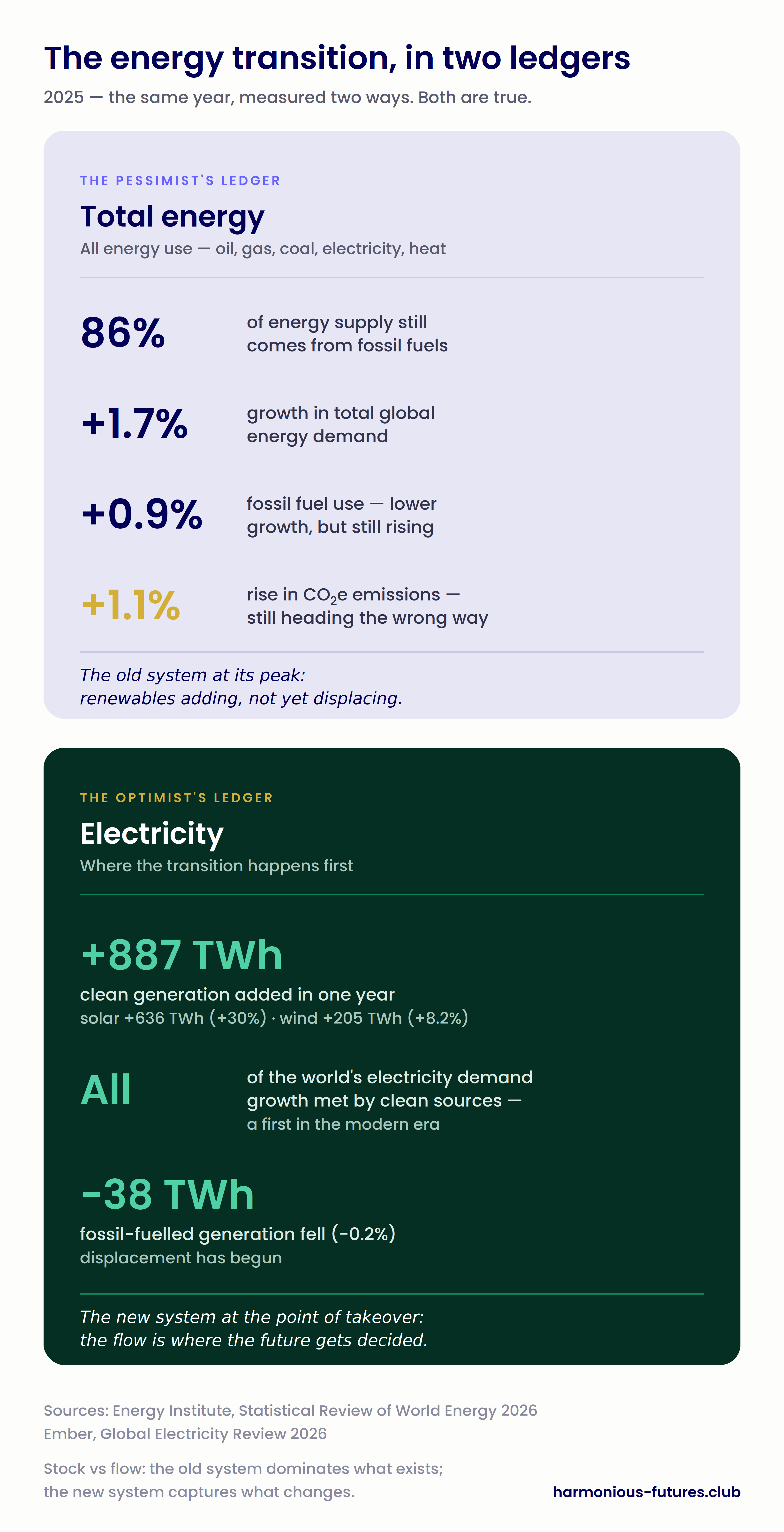
So which report is right? Both. They're measuring different things — one measures the old system at its bloated peak, the other measures the new system at its point of takeover. The old system still dominates the stock; the new system has captured the flow. And in any transition, the flow is where the future gets decided.
But an honest reading can't stop there. Because nature doesn't deal in relatives — in market shares, growth rates, or points of takeover. The atmosphere counts absolutes. And in absolute terms, emissions still rose last year. Hope, if it's to be more than a mood, has to rest on a credible case that the future will behave differently from the past — and technology, however impressive, is only one half of that case.
The biggest sufficiency project in history
Start with the half that technology can deliver.
The fossil energy system is spectacularly wasteful. Roughly two-thirds of the primary energy in the coal, oil and gas we burn is lost as heat before it does anything useful for anyone. Electrification changes that arithmetic. A heat pump delivers the same warmth as a gas boiler for around a third of the input energy. An electric car moves you on roughly a third of the energy of a petrol one.
Which means the energy transition is not one giant machine replacing another. It's civilisation learning to deliver the same lives — warmer homes, working transport, and increasingly the cooling that summers like this one demand — with dramatically less energy flowing through the system. Not sacrifice. Subtraction of waste. You could fairly call it the largest sufficiency project in human history, being driven by economics rather than ideology.
But now the honest crux — the question that decides whether this story is genuinely regenerative, or just growth in green clothing. Economists have known it since the Victorian era as the Jevons paradox: when something gets cheaper and more efficient, we tend to use more of it, not less. And for two centuries, history has mostly been on Jevons' side — efficiency gains reinvested in more travel, more space, more consumption, never yet reducing humanity's absolute footprint. Solar is now the cheapest electricity in history, and still falling. So which way does abundance cut this time? Does cheap clean energy shrink what we take from the planet — or simply fuel bigger cars, bigger homes, more stuff, an economy running the same extractive treadmill on a cleaner motor?
The technology can't answer that question. It supplies capability, not restraint. Efficiency is delivered by engineering and economics; sufficiency is a choice — made by cultures, and ultimately by each of us, at the demand end of the system. Machines can subtract waste from supply. Only we can subtract it from demand.
That's the complete case for hope: not the technology story alone, but the technology story and a culture learning to say enough. Supply and demand, both bending the same way — that's when absolutes fall. And the encouraging news is that we are starting to see concrete action on the demand side too. Not on a solar farm, but at the end of this month, in law — and in church halls and community centres near you.
The right to repair
On 31 July, the EU's Right to Repair Directive takes effect across Europe. From that date, manufacturers of washing machines, fridges, phones, tablets and more are legally required to repair products at a reasonable price — even outside warranty, and even for products people already own. Choose repair over replacement, and — for goods bought from that date — your guarantee extends by a year.
The numbers behind the law are sobering: the EU estimates that discarding repairable items generates 35 million tonnes of waste annually, and costs consumers nearly €12 billion a year in premature replacement. UK research tells the same story from our side of the Channel: 60% of UK adults threw away household items in the past year — toasters, washing machines, hairdryers — many of which could have been fixed.
(Post-Brexit, the UK isn't covered — our own 2021 rules are weaker — though UK consumers benefit anyway, as manufacturers design for the European market as a whole.)
What I love about this story is that nothing is being built, scaled or disrupted. The win is things simply lasting longer — less throughput, same wellbeing. This is a demand-side answer to the Jevons question: a legal and cultural commitment that abundance won't just mean acceleration. One repaired kettle won't cap global demand — but laws and habits like these are how a culture learns that enough is a choice available to it.
And it's not a top-down story either. The law is catching up with a movement that communities started themselves: there are now over 3,000 repair cafés worldwide, over 425 of them in the UK, and volunteers have logged more than 400,000 repair attempts in a shared global dataset. A grassroots movement with better data discipline than some financial institutions I could mention.
So what can you actually do?
This is where I want to land — because an optimistic story you can't act on is just entertainment.
The money angle is the easy part. If you're working to a monthly budget — perhaps trying to build up an emergency fund — repair is a tactic that quietly earns its place. Every repair that defers a replacement is a guaranteed, tax-free saving on a small outlay — immune to whatever markets are doing, and going straight towards the fund instead of the till. When something breaks, make repair the first question rather than the shopping trip.
The deeper opportunity is human capital. Here's a detail from Germany's preparation for the new law that stopped me in my tracks: the repair sector's biggest problem isn't demand — it's that repair businesses are disappearing, because owners are retiring without successors and skilled workers are scarce. Sit with that. Europe has just made repair the expected default across an entire continent — through manufacturer obligations, spare parts and tools for independent repairers, and national repair incentives — at precisely the moment the supply of people who can actually fix things is ageing out.
For anyone designing the second half of their life — looking for paid, purposeful activity on their own terms — this is a case of purpose, demand and timing all pointing the same way. Hands-on, local, sociable, and now growing by legal mandate. And there's a natural pathway in, with an off-ramp at every stage:
- Start by volunteering. Your nearest repair café is a free apprenticeship — in the skills, and in whether you'd actually enjoy it.
- Develop skills alongside. Shadow the fixers, and treat guides like iFixit as your course materials — six months of Saturdays is a genuine education.
- Then scout the local demand. In London, for instance, waves of new residential development mean neighbourhoods full of people and appliances, but short on community facilities — unmet demand with a postcode.
- Pair repair with something people already queue for. Many repair cafés run inside actual cafés and community spaces — repair needs venues and footfall; a café needs a purpose that turns customers into a community. Demand for repair, meet demand for coffee.
And it's worth knowing that funding exists for exactly this sort of opportunity: the National Lottery Community Fund has awarded almost £300m to environmental projects over four years, including repair cafés, with grants of up to £20,000 available through its open-access Awards for All programme. One design note: this funding is open to not-for-profit structures — community groups, charities, and Community Interest Companies ("CICs") — rather than ordinary limited companies. A CIC is a real business with its purpose locked in and its profits capped: you pay yourself as an employee of a mission, not a shareholder of a growth machine. It trades some tax efficiency for funding access and — perhaps — a better answer to what your work is actually for.
I've made a version of this move myself — not into repair, but into work that finally lines up with what I think matters. I wrote about that decision at the time, and added a note eighteen months on about how it's actually gone.
So what is hope?
Which brings us back to Pompeii, and those inscriptions. A warning and an inheritance, in the same stones.
So what is hope, exactly? It isn't optimism — the belief that things will turn out fine on their own. And it certainly isn't a mood, to be lifted by one energy report and crushed by the next. Hope is a credible case that the future can behave differently from the past — and, crucially, a willingness to act like you believe it. Right now, both halves are moving. The supply side is getting cleaner, because the economics finally demand it. And the demand side is moving: new laws, and a growing movement that would rather fix than replace. Slowly, we're learning to say enough.
The heat is real and the risks are real — I'll keep writing about them. But hope isn't something you feel while you wait. It's a to-do list. A repaired kettle. A Saturday at a repair café. A rooftop that generates. A continent quietly rewiring itself because waste is expensive.
I only lasted four hours at Pompeii. The Romans built things that lasted two thousand years. Somewhere between those two timescales is the one that matters: the next ten, in which what we choose to build — and to mend — gets decided.
If this piece resonated, please do subscribe. And if it sparked reflections or questions of your own — or if you've ever eyed up an empty shopfront and thought "café" — I'd genuinely like to hear them. Hit reply, or drop me a line at neil@planetpositiveplanning.com.
Disclaimer: The information provided is for general informational purposes only and does not constitute investment, financial, tax, or legal advice. Please be aware that an investment strategy that is appropriate for one person, may not be appropriate to another, including yourself. Past performance is not indicative of future results. In tailoring your own personal investment strategy it is recommended to speak to a qualified professional.