What the photographs don't show
Moving your pension out of fossil fuels won't cool the planet on its own. The honest reasons for doing it are better than the ones you've been given.

The regulatory bit, before we start: What this is, and what it isn't. I'm an actuary, and my practice — Planet Positive Planning Ltd — provides educational financial services: explaining how things work, and helping people think decisions through. That isn't a regulated activity, so it doesn't require FCA authorisation and Planet Positive Planning doesn't hold it. Regulated advice is a different job — recommending a particular investment to a particular person, having assessed their circumstances. There are moments when that is exactly what you need, and I say so later in this piece. It just isn't what this is. Nothing here is tailored to you, because I know nothing about you.
Looking back at the summer of '26. I imagine it'll be remembered as the first summer when the heatwaves just kept rolling in. Our UK countryside visibly suffering. Our LinkedIn feeds flooded with pictures of yellow, bare fields — reminding us that climate change has very much arrived.
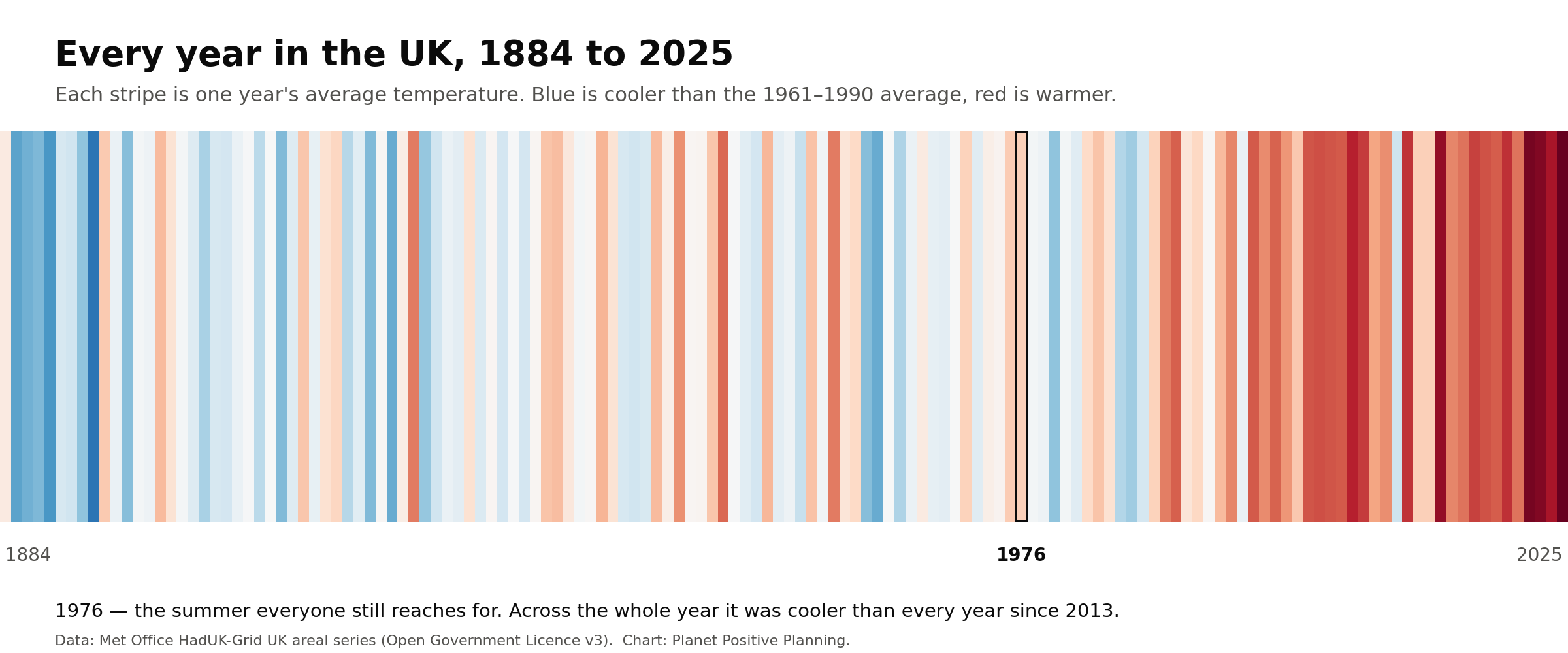
It's also the 50-year anniversary of the summer of '76. A reference point that we still reach for. But 1976 was an anomaly. The UK’s five warmest years on record are now 2025, 2022, 2023, 2014 and 2024 — four of them in the last five years, and every one of the ten warmest has come in the last two decades. 1976 isn’t the comparison any more. It’s the last time a hot summer was genuinely unusual.
Which reminds me of a comment from a recent survey I conducted, asking about concerns for the future:
“... it’s the idea that environmental damage could become the new normal, and we might not even notice how much we’ve adapted to it — hotter summers, unpredictable weather, polluted air, depleted wildlife — all becoming so commonplace that future generations just accept it as ‘how things are.'"
I've always liked to take a photo, as regular readers will know. But there feels like an added poignancy now to photo-taking and album-making. A documented reference of times as they used to be — to make sure we remember that what we were accustomed to, like the “typical British Summer”, was indeed different.
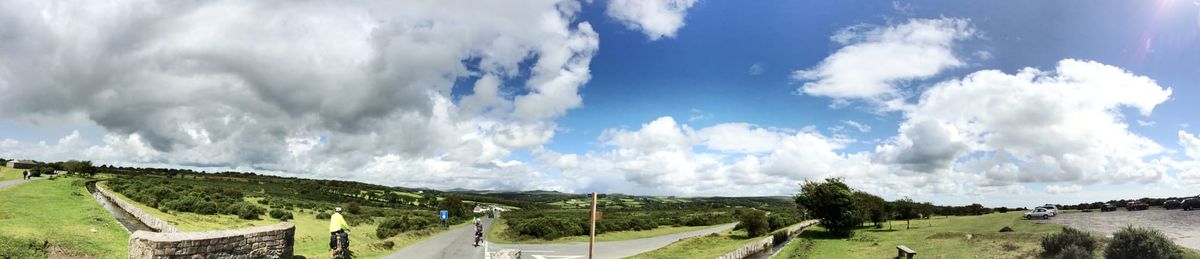
Which explains the choice of lead image. It was taken 11 years ago, in August of 2015. A cycle trip across Devon during a "typical British Summer". Clouds in the sky. Green, lush countryside. Cyclists in raincoats. Because rain showers were to be expected. Feeling lucky if you got some decent sunshine and temperatures above 20°C. That is how it used to be.
Not once, when I took that photo, did I think I’d be looking back at it as evidence that things before were different. A photograph as a record of what the world was.
It makes me wonder whether we’ll come to look back at our decisions in the same way.
One such decision affects us all — and the irony is that most of us in the UK have never actually made it. It’s what our pension is invested in. Changing it is often claimed to be the most impactful thing we can do about our carbon footprint. I think the carbon footprint misses the point.
This article is another longer one. The honest version of this argument takes a while to set out - so grab yourself a cup of tea, or save it for a quiet moment on your commute.
Pensions and fossil fuels
Early in 2025, twelve of the UK’s largest pension providers were scored on their climate action. On fossil fuel phase-out specifically, the average came out at 2.9 out of ten. Nearly all scored zero on policies covering fossil fuel expansion — the companies actively building new oil and gas capacity.
One of those twelve is probably holding your retirement savings right now.
I don’t think that’s a scandal. Nobody hid it. Nobody was ever asked, and the people who could have asked were being measured on something else entirely. Which is the same thing the initial quote described, in financial form: an arrangement nobody chose, that everyone adapted to, that nobody notices.
So — the case for doing something about it. Including the part most people skip, which is what moving your pension actually achieves.
Won't it cost me money?
Start with the numbers, because this is the objection that stops most people.
Compare a global equity index with the same index minus fossil fuel companies (data as at 30 September 2026). Since the index’s base date of November 2010 the fossil-free version is slightly ahead — 12.8% a year against 12.3%. Over ten years it is narrowly ahead too, and over the last five it is about 0.2% a year behind, through the strongest run energy stocks have had in decades. Near enough a wash, in both directions. (Index figures, before costs; the index itself launched in 2014, so the earlier years are back-tested.)
I want to be careful here, because “going green costs you nothing” gets claimed far too confidently in this corner of the industry. The honest version is narrower: excluding fossil fuels from a global portfolio has historically made little difference either way — not because sustainable investing outperforms, but because energy is a small slice of a global index. Duller claim. Better supported.
The larger problem though is that the question looks backwards.
The chart at the top of this piece is measured — every year the UK has recorded since 1884. What a pension is actually invested for is the strip beside it: the next thirty years, in conditions modern markets have never once had to price. There is no historical episode to calibrate against.
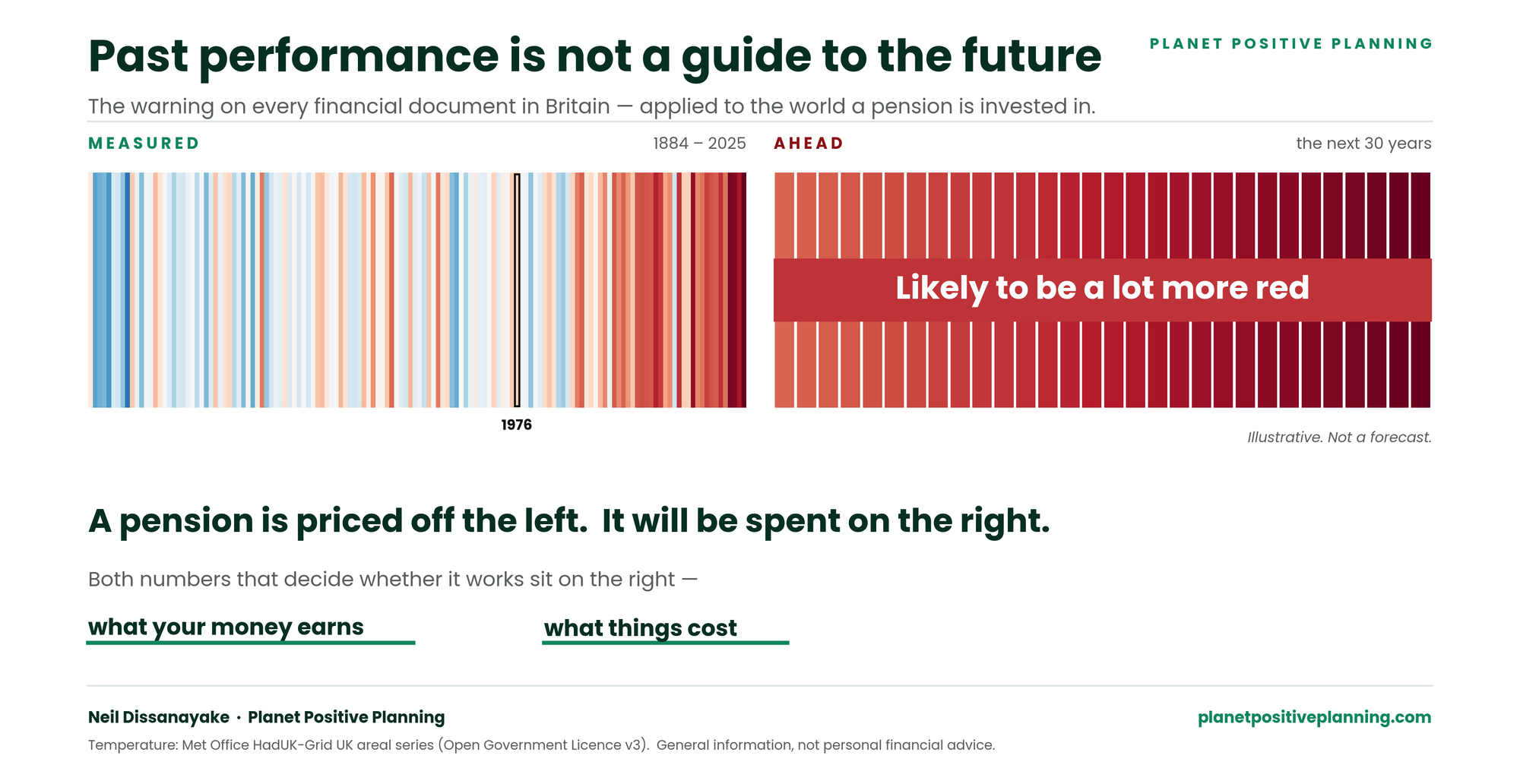
And yet the assumption built into most financial projections is that returns and inflation carry on behaving roughly as they always have. Look at what that asks you to believe — that the physical world can change beyond anything on the record, while the two numbers that decide whether your retirement works, what your money earns and what things cost, go on much as before.
That isn't the cautious assumption. It's the speculative one.
Asking how fossil-free funds have performed assumes the next thirty years will rhyme with the last thirty. That is the assumption actually worth examining.
Look instead at what the industry does with its own money. Global upstream oil and gas investment has flattened at around $550–600 billion a year, roughly 40% below its 2014–15 peak, with exploration spending down about 60% over the decade. Whatever the sector says publicly about demand growth, it is not deploying capital as though it believed it.
Closer to home, the North Sea makes the timing concrete. Output has already fallen by about three quarters since 2000, and even with continued licensing the projections from the North Sea Transition Authority (as reported by Carbon Brief) put oil 91% below today's level by 2050, and gas 97% below. The argument about new drilling is an argument about the rate of decline, not the direction. If you are retiring beyond 2050, the asset at the centre of Britain's energy debate could well be all but finished inside your retirement, even if drilling is permitted to continue.
Then there’s politics. As the physical impacts mount, so does the pressure on governments. Policy that arrives gradually gets priced gradually; policy that arrives suddenly does not. That isn’t a prediction — it’s a description of a risk you are holding right now without being paid much of a premium for it.
And if the answer to all this is fossil fuels are only a small part of my pension anyway — that's true, and it's worth being precise about how small. The energy sector is about 4% of a global equity index, nearly all of it oil and gas. Which is exactly why excluding it barely moves the return: there isn't much there to leave behind. If anything the true exposure runs a little higher, since gas-fired utilities and thermal-coal miners are counted in other sectors.
But run the same number the other way. Under the old "4% rule" for retirement, 4% of a pot is roughly one year of retirement income. Two caveats, and only one of them helps me. I've looked at equities only, and fossil fuel companies issue bonds too — so the whole-pot figure isn't one I can give you. And a disorderly repricing is not a write-off to nothing. But what's exposed still isn't a dented return — it's a stretch of your retirement measured in months.
Small enough to be immaterial on the upside. Not small enough to be immaterial on the downside. That asymmetry is the argument.
Then why hasn't my pension fund already done it?
This is the fair question, and the answer isn’t incompetence.
Mark Carney named it in 2015: the tragedy of the horizon. The costs of climate change land beyond the horizon on which any current decision-maker is judged. Fund managers understand the risk perfectly well. They are also assessed quarterly. Acting on a thirty-year risk at the expense of a three-year number is not a career-enhancing move, and “members’ best interests” has quietly come to mean something far shorter-term than the word suggests.
The second reason I find harder to be relaxed about. In 2023 the Institute and Faculty of Actuaries — my own profession — published a report arguing that the climate scenario models used across financial services, including those behind pension schemes’ own climate reporting, significantly understate the risk. Tipping points and knock-on effects, it said, “simply do not exist in the models.”
So the models say it’s manageable. The models are wrong. And nobody is obliged to act on a risk their own tooling says isn’t there.
Nor is this one bad provider. Of 76 of the world’s largest asset managers assessed in 2025, four had credible fossil fuel policies. All four European. Progress has been stalling since 2022.
But does moving my pension actually do anything?
Here I want to be straight with you, because this is where the subject usually gets oversold.
If you sell shares in an oil company, someone else buys them — and they may care about none of this. One person moving one pension does not move a share price. Anyone telling you your fund switch cuts emissions by a specific number of tonnes is describing an accounting attribution, not a barrel left in the ground.
The alternative — stay invested and push management to change — has a better evidence base than divestment in general. But with the oil and gas majors specifically, given where the industry is now, it has not delivered much.
So what does work?
The best evidence I know of comes from a Dutch pension fund that asked its members what they wanted, with real money at stake. Two-thirds backed more sustainable investment even when told it might mean lower returns — and the fund changed its policy. Not a survey. Not a model. A pension fund that moved because its members said so.
That’s the mechanism. Not the share price — the mandate.
And it’s worth being precise about what sends that signal, because it changes what you do. Telling your provider what you want matters. Moving your money matters more. A letter is an opinion, and opinions are easy to file. A fund switch is a number — it lands in a flow report somebody is accountable for, and if you move provider entirely it lands in the revenue line. Providers watch where money goes far more closely than they read what savers write.
So the switch isn’t only what happens once you’ve been persuaded. The switch is the signal. A saver who moves the money and says why sends both. A saver who only says why sends the one that's easy to file.
Defaults are where this has to land eventually, because that’s where nearly all the money sits and hardly anybody leaves them. Enough people leaving one is the clearest message a provider can receive.
There’s also a slower effect, worth spelling out because it usually gets described badly. The Oxford work on divestment put it this way: campaigns of this kind rarely damage a company’s finances directly. What they damage is its standing — and standing has a price.
Think about tobacco. No boycott ever bankrupted a tobacco company. But once the industry became something serious institutions didn’t want to be seen near, everything around it got harder: lending, insurance, hiring, advertising, political cover. Earnings held up for years; what fell was the multiple the market would pay for them. It isn’t customers thinking less of a brand — it’s an industry’s social licence eroding, and the people who set its cost of capital noticing.
And there’s the other side of the ledger. Every pound in a fossil fuel major is a pound not funding whatever replaces it. Those companies tend to be smaller and less heavily traded, so capital arriving counts for more than capital leaving a mega-cap. That comes with volatility, and I’d rather say so than not. But if you genuinely believe the world is heading somewhere, there’s a reasonable question about whether you’d like to own any of it.
Where this actually leads
Switching a fund sounds like a small thing. Financially, it might be.
What it isn’t is passive. And that’s the part I’ve come to think matters most.
Most of us have been quietly trained not to make active choices about our money. No financial education at school worth the name, and a pension system built so that you never have to decide anything — auto-enrolment, a default fund, a default glide path, a default retirement age. It works, in the sense that people end up with a pension. It also produces savers who have never once made a decision about a sum of money that could shape a third of their adult life.
The climate problem has the same shape. It isn’t only a technology problem, where we swap this fuel for that one and otherwise carry on. It’s a question of whether enough people will change what they do, deliberately, before they are forced to — and the window in which choosing beats being forced is not open indefinitely.
So here’s the honest reason I think this is worth an afternoon. Not because your fund switch will cool the planet — I’ve just spent several hundred words explaining why, on its own, it won’t. Because of what it does to you.
Look at what the pension system quietly assumes. Auto-enrolment assumes you won’t sign up. The default fund assumes you won’t choose. The glide path assumes you won’t review it. None of that is malicious — it’s built that way because it works, and because most people genuinely don’t engage. But it adds up to an enormous, well-engineered system resting on the assumption that you won’t bother.
Deciding to bother is a small thing to do and a strange thing to have done. You’ll have made a deliberate choice about money inside a system designed so that you never have to. And you’ll know something about yourself afterwards that you didn’t know before — not that you care, you knew that already, but that the caring turned into something you actually did.
Most of us carry a quiet, slightly uneasy theory about whether we’re the sort of person who does things, or the sort who means to. This settles it, in one direction, on the record. And a decision you’ve made once is easier to make again — your bank, your energy, the things that feel too big for one person to touch. Not because momentum is magic, but because the first one is the one that proves it’s possible.
It also isn’t as solitary as it feels. A pension switch is a private act, done alone at a laptop on a wet Tuesday. But it doesn’t stay private. It becomes a number — and numbers are what move defaults. That Dutch fund didn’t change because one member wrote a persuasive letter. It changed because enough of them made their preference impossible to ignore.
That is how this kind of change actually happens. Not dramatically, and not all at once. A lot of people quietly deciding the same thing, until the institutions holding the money notice the ground has moved. You don’t get to see your own contribution to that, any more than you get to see your share of a majority. It counts anyway.
There’s something strange about a pension. It’s the longest-dated thing most of us will ever own — money leaving your account this month that you won’t touch for twenty or thirty years — and it’s the thing we think about least. Every month you’ve been posting instalments to someone you haven’t met yet. Without ever once saying what they should be doing in the meantime.
So think about arriving there. Whatever the world looks like by then, you’ll do what I did with that photograph: look back, and try to work out what you understood at the time and what you did about it.
You’ll have a record either way. A photograph is a record of what the world was. An investment decision is a record of what you did about it.
Give your future self something to find.
The how is the fiddly bit
The argument is the easy half. Doing it is harder than it ought to be, and a lot of the tools people point you towards don't work here in the UK — one of the best-known fossil fuel fund screening tools covers US funds only, and says so on its own site.
Two things to sort out before you touch anything.
The first is that I've been describing two quite different acts as though they were one. Changing which fund your money sits in, inside the scheme you already have, is a low-stakes administrative decision you can usually reverse. Moving to a different provider is a bigger one, with more that can go wrong. Many people who want a fossil-free option can do the first, without ever needing the second.
The second is that some pensions carry guarantees worth considerably more than they look — such as a guaranteed annuity rate, or a defined benefit promise. They turn up most often in policies from the eighties and nineties, they are easy to miss, and they are usually lost on transfer. If you have older pots, find out what is in them before you move anything. Where safeguarded benefits come to more than £30,000, you are required to take regulated advice before transferring. That is the law rather than a suggestion, and it is one of the places where the honest answer is go and see an adviser.
The guide, and how to get it.
I’m writing the practical half down: how to find out what your pension actually holds, the routes available for moving it, a list of UK tools that could genuinely help, and a letter you can send your employer. The guide covers the checks worth doing first, what you stand to lose as well as what you can change, and where the real decision points are. It is there to educate you on the process. It is not a recommendation or investment advice, and the decisions are entirely yours.
It will be free, and it goes to subscribers. Beyond that, I make my living helping people work through exactly this question, on a fixed fee — no commission, no percentage of your assets, nothing to sell you at the end. If the right answer is to do nothing, it costs me nothing to say so.
If you'd like a copy when it's ready, and a note when it lands, please do subscribe below.
If this resonated, here are some of my earlier articles that cover similar themes:
• Is it risky to go green with your pension? — the same question, asked a year earlier, before I’d done the digging.
• What if we invented the pension again from scratch? — where the tragedy of horizons argument started, and what a pension designed today might look like.
• The art of retiring well — the other half of the picture. Not the size of the pot, but the shape of the years it has to cover.
Disclaimer:
Planet Positive Planning Ltd provides educational financial services. This is not a regulated activity and does not require authorisation by the Financial Conduct Authority. Nothing here is a personal recommendation, or advice on the merits of any particular investment, fund or provider, and none of it is tailored to your circumstances. An approach that suits one person may not suit another. Past performance is not a guide to future results, and investments can fall as well as rise. For a recommendation for your own situation, speak to an FCA-regulated financial adviser.