The two most important graphs in retirement planning
Two graphs that should change how you think about planning for later life — and why the comfortable version we've been sold no longer holds.

I spent last Saturday at an online gathering of about 150 souls. Founders of Extinction Rebellion, climate scientists, new-wave economists, journalists. Not a group that tends to soften its message.
It left me feeling even more emboldened to be honest and frank – about our future.
Most retirement planning quietly assumes a stable world. Not explicitly — nobody writes it down — but it's there in every projection: markets that recover, inflation that behaves, a climate that stays roughly within the range our models were built on. That was a reasonable assumption for most of the last century. For the next thirty years, far less so.
This article isn't about frightening anyone. It's about putting two pictures in front of you that belong in any honest conversation about later life — and then asking what a plan needs to look like if you take them seriously.
The first graph: Where we are
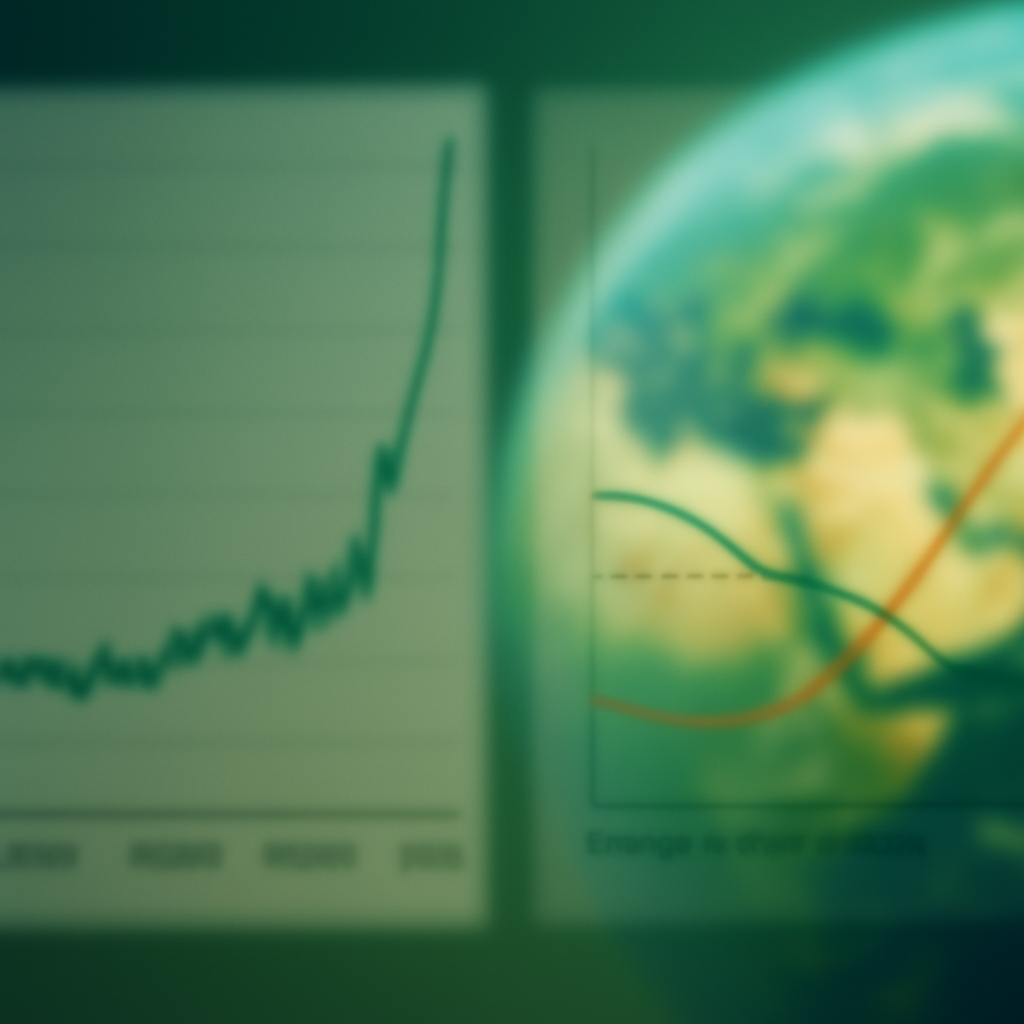
This is a screenshot I took during the session, so treat the precise numbers with some care — I haven't been able to pin down the exact basis behind them, and I'd rather say so than pretend otherwise. But the shape isn't in question, and the shape is the point.
Greenhouse gases in the atmosphere over the past 130,000 years. For almost all of that time the line barely moves. Then, at the very right-hand edge, it goes vertical.
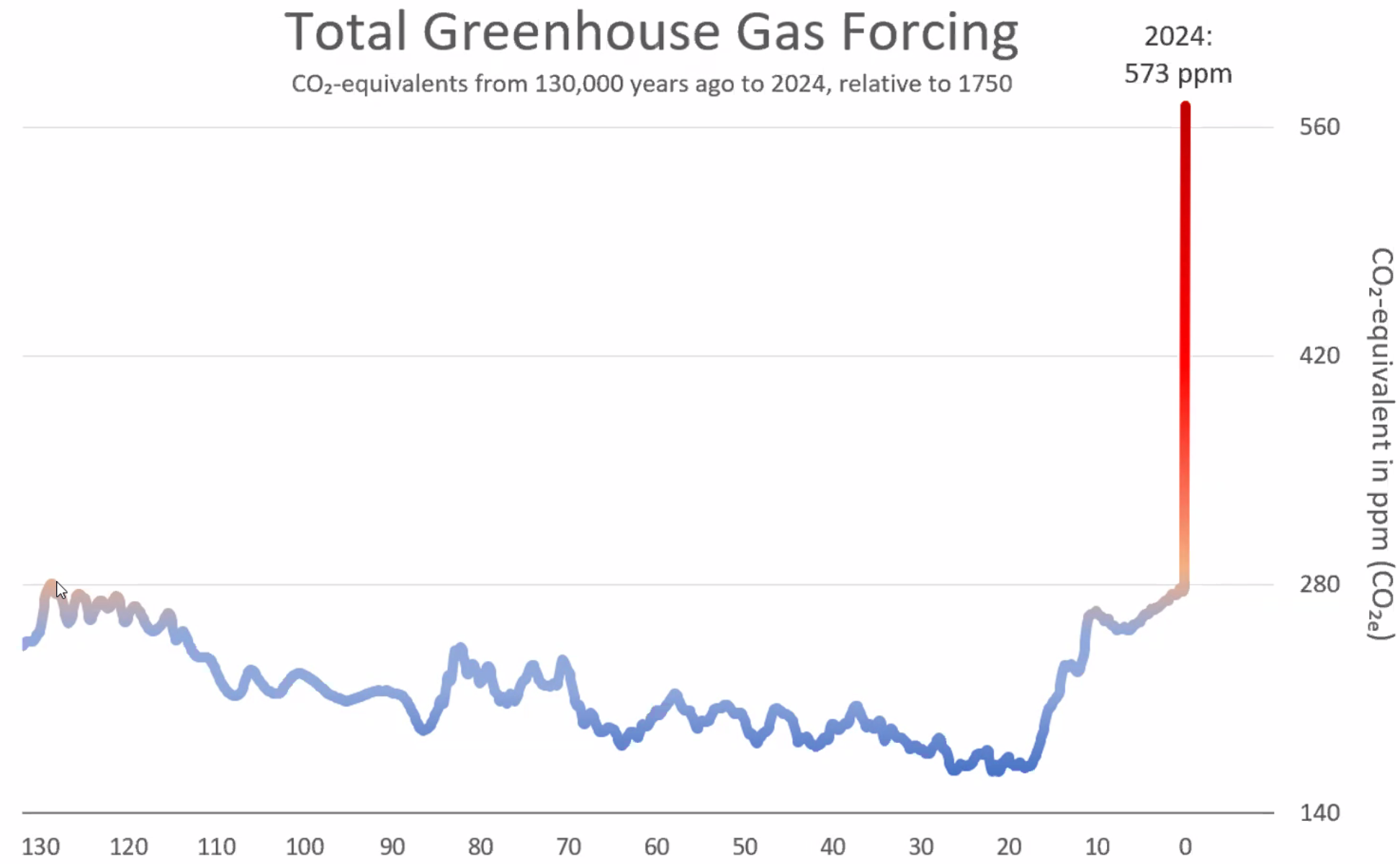
Most of us have seen a version of this before. That's rather the point — it's familiar enough that we've stopped looking at it properly. But it's worth sitting with, because everything else here follows from it. The world your pension will be drawn down into is not the one it was paid into.
The second graph: The part I hadn't appreciated
The second was new to me, and it's the reason I'm writing this.
Burning fossil fuels doesn't only release greenhouse gases. It also releases aerosols — sulphates and particulates — which reflect sunlight and have a cooling effect. So the warming we've experienced so far is less than the warming we've caused. The pollution has been partially masking its own consequences.
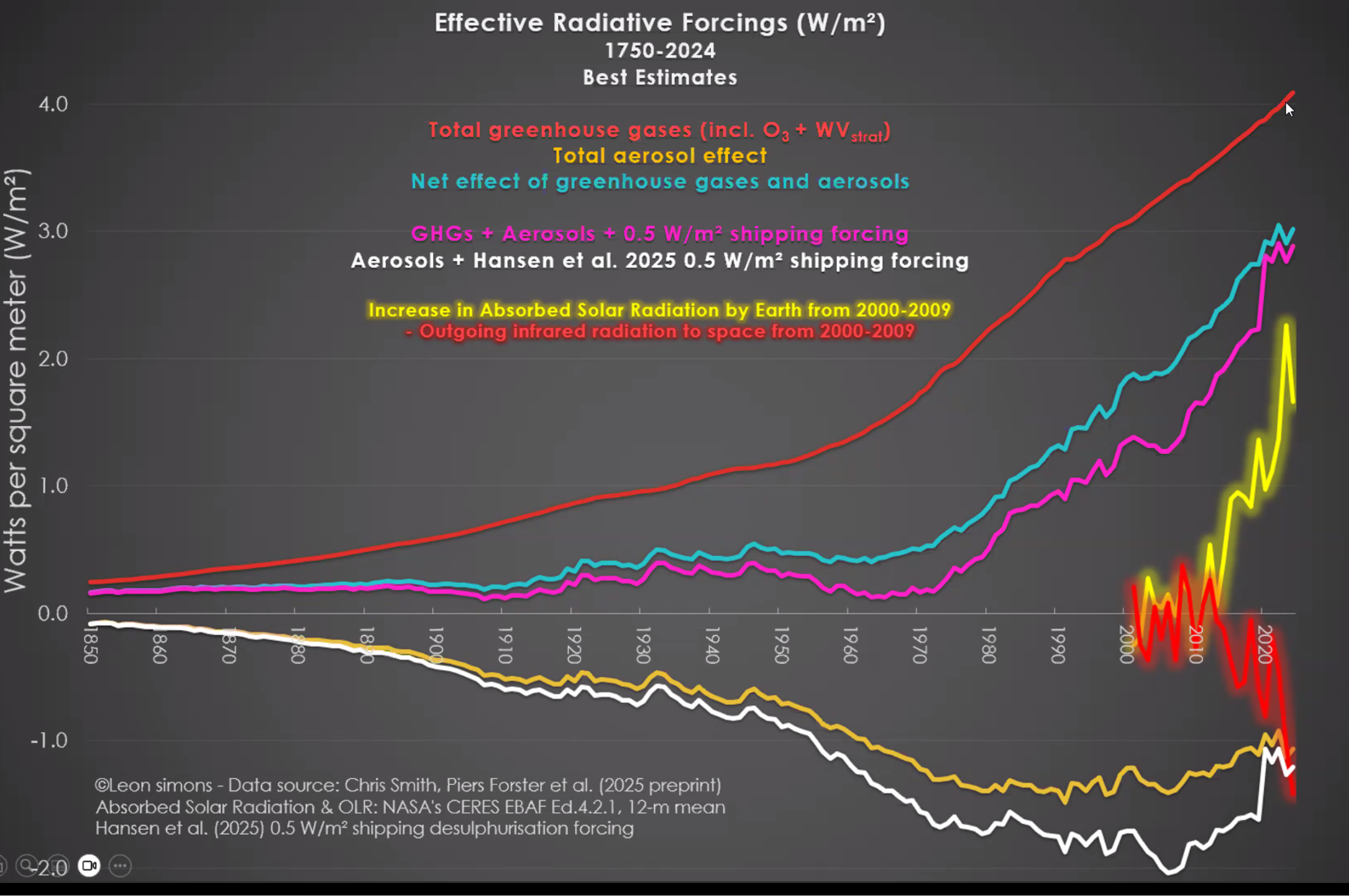
Which produces an uncomfortable wrinkle. As we clean up the burning — which we must, and are — that masking fades. The warming we've experienced is not the warming we've already bought. It cuts against the intuition most of us carry: that cutting emissions translates fairly directly into a cooler outcome. In the long run it does. In the short run there's a lag, and it doesn't run in our favour.
What follows - and what doesn't
Two things follow honestly from all of this. A third doesn't, and it's worth separating them.
What follows: the baseline has gone. Not that catastrophe is certain — but that "roughly like now, only more so" has stopped being a reasonable thing to plan around. Some of what's coming is unavoidable, and holding warming to 1.5°C looks increasingly out of reach (many now saying that target is no longer possible). That's the hard part, and pretending otherwise helps nobody.
What also follows: what we do next still determines how much more. That isn't optimism, it's arithmetic. The gap between the paths still ahead of us is wider than the gap between where we are now and where we were.
What doesn't follow: that there's nothing left to be done. I heard that said at the event, and I understand the feeling behind it. But it isn't what the evidence shows. Solar module prices fell by around a third in a single year. Pakistan installed solar capacity equivalent to a third of its entire generating fleet in twelve months. Across the Global South, renewables are going in at roughly twice the pace of the rich world — not out of virtue, but because the economics now favour it. None of that solves the problem. All of it says the trajectory isn't fixed.
Both things are true at once. That's harder to hold than either extreme, and it's the only honest place to stand.
This isn't a fringe view
If this sounds like it belongs at a protest rather than in a financial plan, it's worth noting who else is saying it.
Allianz, one of Europe's largest insurers, has warned that climate change is on course to make large parts of the world uninsurable — and that an insurability crisis would work its way through mortgages, lending and asset values. Norges Bank, which runs the world's largest sovereign wealth fund, has been preparing for economic disruption on a scale beyond 2008. JP Morgan's own analysis has assumed a 3°C world.
Though their conclusions aren't always inspiring. JP Morgan, as far as I could tell, concludes that the opportunity is air conditioning. A three-degree world, met with a product recommendation. [Insert your own expletive].
But the point stands, and it's worth holding on to. The institutions with the most money and the most modelling capacity are not treating this as a distant hypothetical. They are pricing it. The people telling you the future will be calm are not the ones with money on the outcome.
Where the room went - and where I've landed
I should be straight about something. The room I sat in was more radical than this article is. These were people who have been arrested for this, who talk in terms of revolution and mean it literally. I'm not going to pretend I've landed where they have.
But I left less able to argue with them than when I arrived. And unwilling to write another piece that treats all this as a modest adjustment to the assumptions.
Because that is the thing the graphs settle. The choice isn't between change and no change. It's frankly between "degrowth by disaster" and "degrowth by design" — between a system that unravels on its own terms, and one we deliberately rebuild on better ones. Carrying on much as before isn't one of the options on the table.
So what does a plan look like?
If you take these graphs seriously, the conclusion isn't that planning is pointless. It's that the plan most people are handed isn't the cautious one it appears to be.
A retirement resting entirely on financial markets delivering, reliably, across thirty years is a concentrated bet. It gets dressed up as prudence, because it's what everyone does and because the modelling looks reassuringly precise. But precision isn't safety. A single assumption doing all the work is the definition of fragility — and it's the default almost everyone is sold.
The response isn't to abandon it. It's to stop asking it to carry everything.
And the encouraging part is that the assets which hold up best in an uncertain world are the ones worth having anyway. A healthspan you've invested in. A network you've nurtured. A purpose that pays a little and means a lot. A guaranteed floor under your essentials. A home that costs less to run. None of that depends on which way markets break, or on what the next decade does to the wider world. It depends on you.
That isn't a consolation prize. For most people it's a better life than the version with the margaritas on a beach.
Five places to start:
None of this is sufficient on its own, and I'd rather say that than pretend a five-point list solves any of it. But they're where I'd start — and they climb from what you control to what we only change together.
1. Question the assumption of normal. Most projections you'll be shown treat the past as a guide to the future. Ask what happens if it isn't — and notice how few people are asking.
2. Plan for resilience, not just returns. Diversify what your future income comes from, not just what your portfolio holds. State pension, part-time work, rent saved or earned, a small business, a floor under your essentials. A plan that survives one bad decade beats a plan that optimises for a good one.
3. Invest in what can't be taken from you. Your health, your skills, your network, your ability to earn on your own terms. Keep learning — the ability to adapt may be the most valuable asset you can build, and the transition ahead needs people rather more than it needs capital.
4. Put money and time into the real economy. Local food systems, community energy, retrofitting the home you already own. Outcomes you can see, and returns that don't depend on market sentiment.
5. Find your people, then say something. This is a difficult subject to sit with alone. London Climate Action Week has many free events and is a good way in if you're near enough — and you're reading one already. Then say the thing out loud: to your pension provider, your employer, your friends. Nothing above shifts the system by itself. What does is enough people making the change visible.
Where this leaves us
Jeremy Lent writes about what he calls an ecological civilization — a society organised around the flourishing of life rather than the accumulation of wealth. Citizens' assemblies in place of concentrated power. Common ownership. Work directed at regeneration. It's a long way from where we are.
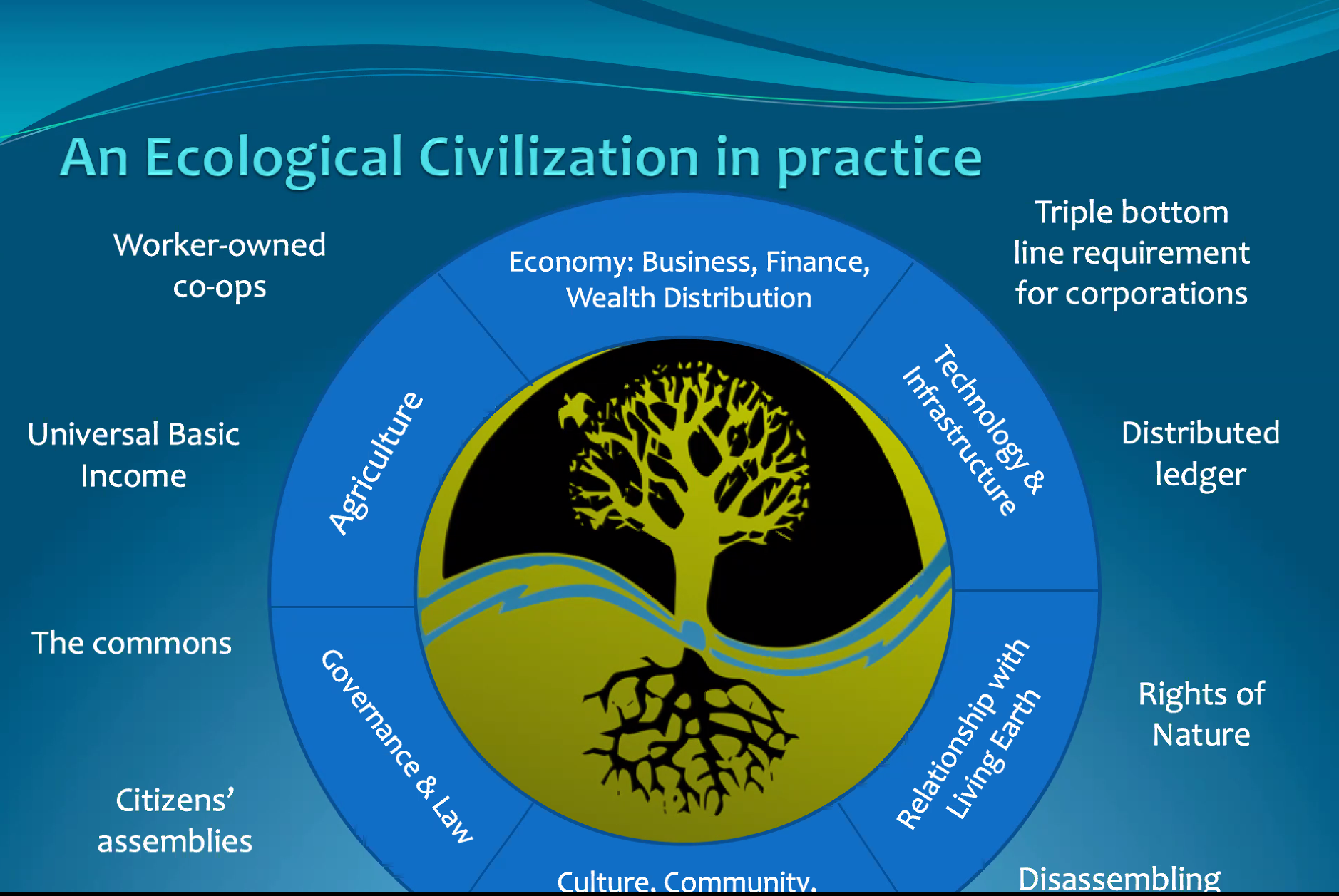
I don't know whether we get there. But I've stopped thinking that's the right question. The system is going to change — that much the graphs settle. What's still open is whether it changes by design or by disaster, and that gets decided by how many people choose it before it's chosen for them.
Every person who moves their money, changes their work, or backs something regenerative is a small proof it can be done deliberately. That's how systems shift: not through a single moment, but through enough people quietly modelling something better that it stops looking unusual.
The two graphs are real. So is the range of futures still ahead of us. Planning honestly means holding both potential outcomes — and then deciding which one you're going to work for.
That's a lot to sit with. If it's raised questions or thoughts of your own, I'd genuinely like to hear them — hit reply, and I'll answer.
And if someone came to mind while you were reading, particularly someone who'd act on it, please pass it on.
Disclaimer:
The information provided is for general informational purposes only and does not constitute investment, financial, tax, or legal advice. Please be aware that an investment strategy that is appropriate for one person, may not be appropriate to another, including yourself. Past performance is not indicative of future results. In tailoring your own personal investment strategy it is recommended to speak to a qualified professional.